Sunday, December 14, 2025

The Four Avengers Versus the Elephant: Two Tales from the Panchatantra by Meena Arora Nayak (Book Review: 4*/5) !!!


15th Book of 2025

Reading children’s books can be quite interesting when you want to read something light while having tea or coffee at someone’s home—especially when they have kids for whom such books have been purchased. I took advantage of a similar opportunity and read a book titled “The Four Avengers Versus the Elephant” published by Aleph. The book consists of two tales from the Panchatantra, retold by Meena Arora Nayak.


The book is meant for children above the age of nine, as the author has ensured that even though her stories are targeted at kids, they are written in a way that imparts knowledge beyond the basics. I, as someone in my mid-30s, could also find wisdom in the way these stories are narrated. Nayak uses conversations between animals as a medium to deliver life lessons and Chanakya-like insights. Many dialogues are written in a manner that resembles explanations of ancient Sanskrit shlokas.


The first story focuses on the qualities and responsibilities of a king. Within the same tale, the author highlights how a vulnerable animal like a hare can outsmart a mighty lion who is ready to kill and eat him. The way the hare leads the lion to his own death is told very intelligently and gives hope to anyone who considers themselves weaker than others.


Similarly, the second story narrates how four small animals and insects unite to defeat an elephant who had been troubling one of their friends. This story beautifully signifies how the power of unity can bring even the most powerful to their knees.


Overall, I loved reading this book. I rate it 4 stars out of 5. I just feel that children’s books like this shouldn’t be priced as high as they often are — hopefully, publications can find a way to make them more affordable.

 PURCHASE THE BOOK HERE

Thanks!


WRITING BUDDHA

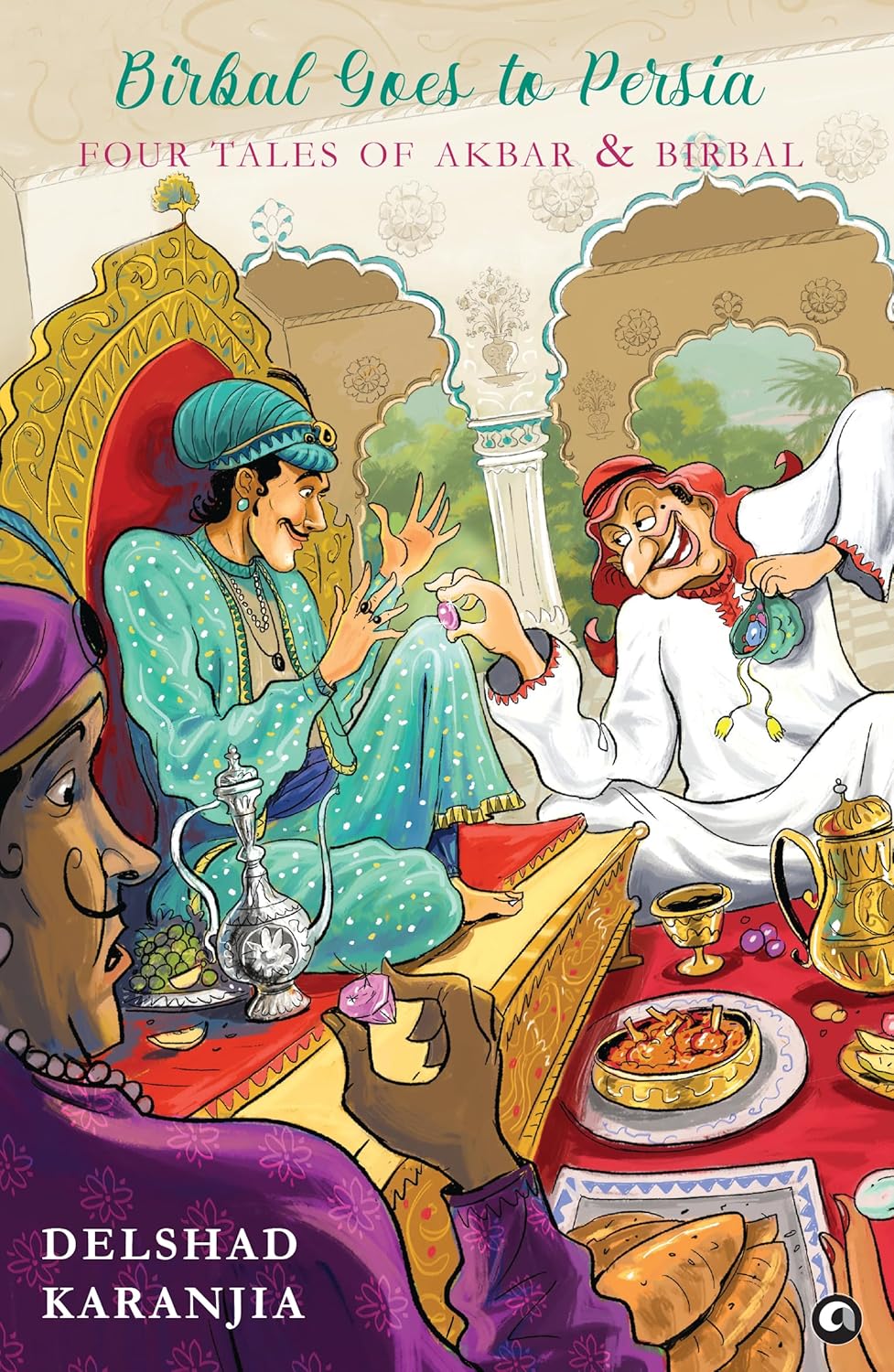
Birbal Goes to Persia: Four Tales of Akbar and Birbal by Delshad Karanjia (Book Review: 4*/5) !!!


14th Book of 2025 

I remember my father instilling the habit of reading books in me right from my primary schooling days. One of the most popular stories during those years was the Akbar-Birbal tales. I used to think that kids these days wouldn’t be reading about Akbar and Birbal, but I was pleasantly surprised when I found a few such books at one of my relatives’ homes. It took me just 20 minutes to complete this book titled “Birbal Goes to Persia,” which consists of four tales of Akbar and Birbal — all distinct from each other. The stories have been retold by Delshad Karanjia, who has been a journalist by profession.


All the stories are witty, funny, and humorous, and each provides a life lesson at the end. The first story in the book, A Lesson for the Emperor, tells a tale where Birbal gives a profound lesson to Akbar, making him realize that everything in life is temporary and that worldly possessions do not belong to anyone permanently, as every person is merely passing through Earth and must die one day.


The second story, Birbal and the Shah, is another example of Birbal’s cleverness, where he manages to impress both his own king as well as the ruler of another country by complimenting each of them in their respective presence — changing the perspective of his statements in both instances.


The third story, Catching Thieves, actually tells two different tales where Birbal faces the challenging task of finding a thief. He uses his intelligence and gives a task to the suspects, through which he cleverly identifies the real thief without conducting any formal investigation.


The fourth story, A Tax on Fools, serves as a fitting conclusion to the book. It narrates how Birbal challenges Akbar’s idea of imposing a tax on fools and, in turn, proposes imposing a tax on wise people instead. This was the first time I read this particular story, and I really liked it.


Overall, the book is engaging, and children are definitely going to enjoy it. I give it 4 stars out of 5.

PURCHASE THE BOOK HERE

Thanks!


WRITING BUDDHA


Sunday, November 9, 2025

Will India Get Rich Before It Turns 100? : A Reality Check by Prosenjit Datta (Book Review: 3.5*/5) !!!


13th Book of 2025


Anyone who regularly reads newspapers knows how often we come across discussions about India’s economic growth, its vision of becoming a developed nation, and the dream of achieving this by 2047. Most of these articles, however, feel incomplete—they leave us wondering how this progress is actually measured and when it could realistically happen. That’s exactly what Prosenjit Datta attempts to explain in his insightful book “Will India Get Rich Before It Turns 100?” Published by Aleph Book Company, the book carries the apt tagline “A Reality Check.”


This 120-page analysis is divided into three main parts. The first section explores how predictions are made, how a nation attains the “developed” status, and the role of assumptions, macroeconomic modeling, and optimism. The second section focuses on critical issues such as whether India’s demographic dividend is a boon or a curse, job scarcity, and recurring factors behind India’s economic slowdowns—wars, global disruptions, the pandemic, demonetization, and GST. The third and final section outlines policy direction and economic stability, offering Datta’s thoughts on how India might still reach its ambitious 2047 milestone.


Datta begins the book on a witty and relatable note, recalling how politicians once made short-term predictions for 2020 or 2025 but, after facing uncomfortable questions about unmet goals, have now safely shifted their forecasts to 2047 and beyond. It’s a clever and engaging start—especially for a book tackling such an academic and socio-economic topic.


Throughout the book, Datta explains various economic ratios and calculation methods used by institutions to assess India’s current and future standing. He insightfully argues that GDP alone cannot define a country’s success, as it fails to capture citizens’ quality of life and everyday realities. The book also introduces readers to several useful abbreviations and concepts that broaden one’s understanding of how multiple factors determine a nation’s growth trajectory.


One of the recurring themes Datta emphasizes is the absence of an updated census for more than a decade, which hinders effective policymaking. He also discusses Artificial Intelligence (AI), acknowledging both its overhyped expectations and its transformative potential. Impressively, Datta remains objective in his tone—he points out how under both Congress and BJP regimes, India’s economy has seen phases of stagnation rather than the continuous upward trajectory one would expect.


Overall, Will India Get Rich Before It Turns 100? offers meaningful insights and a fresh perspective on India’s developmental challenges. That said, I felt the author could have explored more dimensions to strengthen his arguments—perhaps by referencing other economists or reputed media analyses. Dividing chapters by major sectors like Banking, Agriculture, IT, Manufacturing, Retail, and MNCs could have further clarified how each contributes differently to India’s economic journey.


This book is a quick yet impactful read for anyone curious about India’s growth story, economic policy, and the country’s long-term vision.
I would rate it 3.5 out of 5 stars.

 PURCHASE THE BOOK HERE

Thanks!


WRITING BUDDHA

About Me

My photo
Book Reviewer | Movie Reviewer | Bibliophile | Business Analyst