Tuesday, December 20, 2022

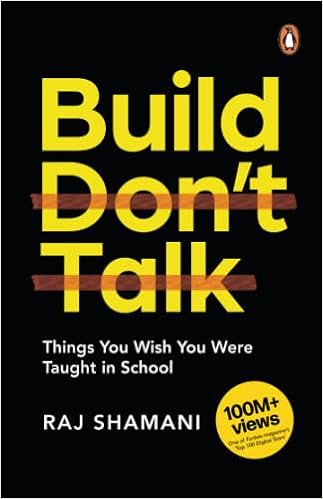
Build, Don’t Talk by Raj Shamani (Book Review: 4.5*/5) !!!


33rd Book of 2022


I remember when lockdown had hit all of us, we didn’t have any new movies to watch or restaurants to try. The only saviour that was left for our entertainment was Youtube. This was the time generally when Youtubers and Influencers grew like anything. There were many new names that got introduced to us. One such name that Instagram algorithm made me aware was of Raj Shamani. His reels would occasionally appear on my feed. Initially, I thought who’s this boy giving so much of gyaan but eventually, I started agreeing with few of his viewpoints. I finally subscribed him on Youtube when he started Podcast named “Figuring Out” and I love the way he dwells into important questions with the entrepreneur guests on his show. I was surprised when I saw that his book has also got published recently named “Build, Don’t Talk” by the No. 1 publisher of India, Penguin. It didn’t take me two minutes to order it’s Kindle version and start reading.


The book basically claims to teach us things that weren’t taught us in school. Now, frankly speaking, schools had a set of subjects and they never thought of teaching anything beyond it. The life skills were left upon parents to teach their kids. Unfortunately, parents also kept insisting us to focus on the subjects as good marks meant good job in future. It was surely true because when all of us were growing before the Internet culture came in place, we didn’t have much option to explore except getting a good degree and job to feed ourselves and our family. It is a good initiative by these influencing youth of 25 years old speaking about what they have learnt from their own experiences while walking on an unconventional path.


The book is divided into 39 chapters. Raj’s writing style is very simple. Anyone – who is even in 5th standard would be able to read and comprehend the life-transforming meaning behind the sentences written in this book. Raj has a good reading experience which can be seen in the way he has written it. Every chapter has Key takeaways marked in the end for us to note it down which can give us the summation of the whole chapter as reference. Raj has not shied away from telling things which might sound hard to accept as it challenges your belief system continuously. I had smirk on my face in initial few pages but when I understood that Raj is not going to speak anything which can give me dopamine rush, I pulled up my socks to read things I am going to completely disagree with. And that’s the beauty of this book.


The book covers various topics such as personal growth, habit formation, Raj’s personal experiences and his learnings from it, skills to possess as a student, goal-oriented preparation, start-up ideas, money-building attitude, being a content creator, starting Youtube channel, investment tips, personal branding, creativity and what not. He unapologetically promotes hustle and hard-working culture which is inspirational and agreeable. He doesn’t speak of terms like work-life balance, traveling, making loads of friends because he has been a practical guide throughout the book which is actually needed to be successful in your studies, job or business – whatever you choose for yourself. If for nothing, one should read this book for his honesty.


Let me point out few points/advises given out of many that I liked in the book:

More than goals concentrate on habits and set a process and routine to get to your goals

I liked the truth about copying others by getting inspired rather than focusing on innovating as not everyone can do that.

Being a Producer on Internet than just being a Consumer echoed my own thoughts – The reason why I review books and talk about it.

Shamani talks nicely about how to increase price of your product gradually by charging more to your customers – and why it’s better to have less customers giving more money than having many giving less.

Negotiation chapter is great where he tells how to shift power to another person wittingly and rather than reducing price, adding services is a better option while selling your product/service.

He asks people to stay off social media and start doing things rather than only planning or waiting for the right time.

The chapter on failure is the real hustle talk that Raj gives which tells about the mindset with which few people work - something not everyone is agreeing these days.

The 5 investing tips author gives for beginners really sounds effective. Anyway, someone can authorize it only after implementing. ðŸ˜Š

The way his 7 sources of income stream started one after another and just at 25, the way he is earning money is really inspiring and something to learn from. I really got motivated from that chapter.

It is always interesting to read how content creators work Behind the Scenes and Raj Shamani tells how he plans everything. It has given me lot of insights as to how I can also up my Social media game which is having a slow run.

He has also spoken in length about communication and people skills which are highly effective as some techniques have been applied by me in past which were really helpful in getting opportunities later on.


Overall, this is a great motivational book. Do pick up if you are in need of motivation recently. You can also gift it to your friends, younger siblings, cousins etc. who have big dreams but remain unfocused and indiscipline. I am really a Raj Shamani’s fan now. This book has done wonders to me. I give this one 4.5 stars out of 5.


PURCHASE THE BOOK HERE


Thanks!


WRITING BUDDHA


Monday, December 19, 2022

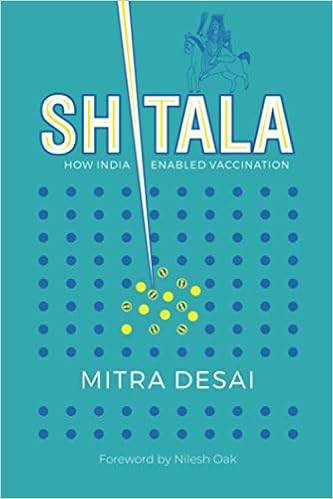
Shitala: How India Enabled Vaccination by Mitra Desai (Book Review: 4.25*/5) !!!


32nd Book of 2022


I read another book this weekend within few hours named “Shitala” written by Mitra Desai. This 97-pages book also has a tagline which says “How India enabled Vaccination”. Initially I thought that it must be about Covid vaccination drive by its title due to the pandemic times but when I read its synopsis, I understood that this is more about how vaccination actually originated from India in ancient times. So, this is a story about a girl, Tara, who keeps indulging in conversation with her grandfather. In one such conversation, the topic of vaccination comes up. They start talking about smallpox where her grandfather claimed it’s vaccination to have been derived from India. It took Tara only few moments on Internet to search and tell him that it’s not India but a man named Edward Jenners from West. This conversation then takes her towards researching more and finding out facts which not only surprises her but even the readers reading this book.


Talking about Mitra’s writing style- it’s very smooth. You will be able to complete reading this book within a sitting itself. It took me around 4 hours because I was also creating notes. The book has lots of knowledge – not only of ancient Indian techniques but also about how vaccination was worked upon in modern era. I am glad that author didn’t try to sound biased in his narration of story but keeps discussing both the sides like a debate which makes reading this story more interesting. I am glad that author chose this fictional way of telling such important facts which otherwise goes unnoticed due to boring way of representation.


Author has only gone up to the details which was actually required for proving the point for which the story was being told. There is no unwanted or unnecessary detailing. Through Tara, the way whole Edward’s journey of vaccination is detailed is very informative. I liked how Desai revealed Westerners for twisting the facts and removing the important inputs from Indian land which was provided during the treatment of Smallpox. Later on, when Indian way of treatment is explained, it’s such a matter of pride that we were involved in such inventions from as long as 7th century.


The references of Ayurveda help reader understand that it’s not only about what diet to eat and not eat but also about other informative medicinal and medical practices. There is a detailed reference section after the story ends which proves the kind of research author has gone through to write this interesting and informative story which I believe should be made part of every school’s library in India. The narration keeps mentioning the Hindu rituals and praying in the home of protagonists which is a nice way to represent our culture and make the new generation aware of it without being preachy.


The story also teaches that we should keep our ego aside to learn new things in life otherwise we will stick being adamant with our perspective and miss out learning the real facts. There’s also a dream sequence of Bhagavad Gita in the pre-climax. It gave me goosebumps. I just couldn’t stop imagining Lord Krishna in my mind after reading it. I had almost a similar experience 2 years back and I am surprised to see how something similar has been scripted so perfectly. In the last chapter, there’s a segment which gives you immense motivation. The way the character of Tara has been treated enables a lot of possibility for readers to learn not only about our ancient achievements but attitude and approach in life.


Overall, this is an interesting read and I recommend everyone to give it a chance. Take it with you on your next flight or train journey and you’ll never forget that trip ever. I give this book 4.25* out of 5.


PURCHASE THE BOOK HERE


Thanks.


WRITING BUDDHA


Maxims from Mahabharata by Sridhar Potaraju (Book Review: 3.75*/5) !!!


31st Book of 2022


Since last decade, the way Sanatan Dharma is being spoken and spread to its own people who didn’t even know that the Dharma they follow is called Sanatan and not Hinduism – the word we keep referring in religious context. I must have read more than 100 books which speaks about our ancient history which few people refer as mythology in either fiction or non-fiction formats which is great as people are getting to learn about our own religion in easier language. I recently completed one similar book sent to me by Indica Books called “Maxims from Mahabharata” written by Sridhar Potaraju.


This is a short-book not even of 100-pages with 12 different chapters. You must be wondering what is the meaning of the word “Maxim”. So, it basically means “few words that express a rule for good or sensible behavior”. Here, author has read Mahabharata and he feels that it’s an ocean of knowledge which talks not only about religion but a lot about human beings and their philosophy and psychology. He tried to pick few which he had noted down or highlighted while reading the same. The 12 Maxims that is discussed in this book chapter-wise are Dharma, Truth, Principles Governing Punishment, Karma, Hygiene as Good Conduct, Nature, Faith, Anger, Reputation, Eternal Values, Mental Health and Power of Words.


Each of these chapter consists of shlokas picked up from Mahabharata which are written in the Sanskrit text itself along with English text for English readers to help them pronounce it. It further has its one-liner translation and the exact chapter or parva in Mahabharata from where it’s picked up. Author also provides context before providing the shlokas so that the reader is able to understand who spoke it to whom and under what situation. This helps in avoiding misinterpretation of the shlokas and referring to it in wrong context – something that atheist or people not believing in our ancient history regularly do to disrespect it.


The book helps you understand how advanced our ancient texts are where they not only cover the then contemporary issues but also speaks in context that it sounds relevant in our modern time too. In the chapter of truth, there’s a mention that if a person is truthful, it’s a bigger good karma than reading all religious books. I evaluated and found it to be so true. If a human being restricts himself in being truthful always – the kind of image he’ll have in society plus the kind of people who’ll want him to be on their side or have him in their team will give him great fortune. Not only this, it also mentioned 13 forms of truth which are Impartiality, Self-control, forgiveness, modesty, endurance, goodness, renunciation, contemplation, dignity, fortitude, compassion and abstention from injury.


Similarly, I liked the way forgiveness has been explained where it is asked to forgive someone who has made mistake so that he/she can get a chance to improve in future. Punishment always is not the right solution. It also talks about punishing someone definitely if the mistake is repeatedly being committed knowingly. I felt this to be so relevant in our professional and corporate life these days. Some managers don’t have these basic skills of understanding when to punish and forgive due to which the career is affected of many employees.


In the Karma maxim, you will just get into the self-evaluation mode when you will read that it has been said – everyone knows their deed – if what they are doing is right or wrong. Still if one chose to go with it, the karma will definitely return back. I was wowed by this. We, as human beings, definitely know about the quality of our action if it’s good or bad still we do it thinking that we will never suffer by it. There are chapters which tells about the significance of protecting nature, maintaining good hygiene, concentrating on our reputation and managing our anger. All this talks about the variety of topics on which Mahabharata is able to guide us upon.


The chapter on mental health again open our eyes as we think this is a modern concept whereas our texts have given its challenges and remedy thousands of years ago. The book also teaches about humility – speaks on son and daughter equality – the consequences of having ego and how it takes everything away from you. Overall, the book is a good beginning for people trying to understand a little bit about the kind of lessons our epics deliver.


Now talking about the drawbacks- firstly, the same context is repeated multiple times which makes it boring and monotonous. Author could have someone arranged the chapters in a manner where for a single context, listing down all kind of lessons we can learn for different maxims. Secondly, the English text for Sanskrit is not appropriate. If you’ll read it, you’ll pronounce it completely different than what it is. Thirdly, I feel that the book could have consisted more shlokas with detailed explanation like a full-fledged book rather than a short read.


Overall, this is a fine attempt which must have taken lot of efforts to compile and put together. I would give the book 3.75* out of 5.


PURCHASE THE BOOK HERE


Thanks.


WRITING BUDDHA


About Me

My photo
Book Reviewer | Movie Reviewer | Bibliophile | Business Analyst